A big part of SEO is knowing what keywords your potential customers use. You will need these keywords for your On-site SEO optimization. Most often you can just think of the biggest one in your head, but you will often be surprised as to what your potential customers use for keywords. After reading this blog you will know exactly how you can find all relevant keywords for your business.
What is keyword research?
Keyword research is the activity of doing research to find the words people fill in search engines to find certain products or services. Your keyword research is the guide you will follow to start creating content for your website. These keywords will be used in copy, images, tags and more on-site optimization ranking factors.
Keywords are divided into two groups: Short-tail and long-tail. A short-tail keyword is a single keyword, for example: Frying pan. A long-tail keyword consists of several words, for example: How to clean a frying pan? Both are just as important for SEO, and long-tail keywords are often better than short-tail keywords.
Why is keyword research important?
Without keyword research, you can not start optimizing a website for SEO, it’s as simple as that. This will also give you a lot of knowledge about your target audience, because you will understand exactly what they’re looking for and what products/services they are interested in the most. Using the right keyword, which you can only do by having done keyword research, will greatly influence the relevancy, search volume and will give you better results compared to the semantic or related keywords. Once you have done a thorough keyword research you can start on making a plan to get started on reaching your goal.
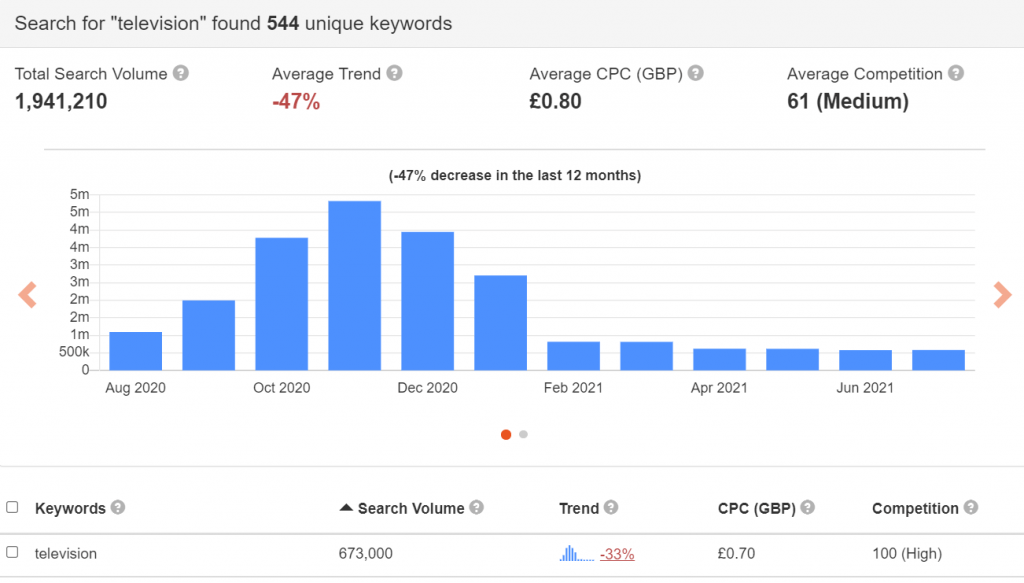
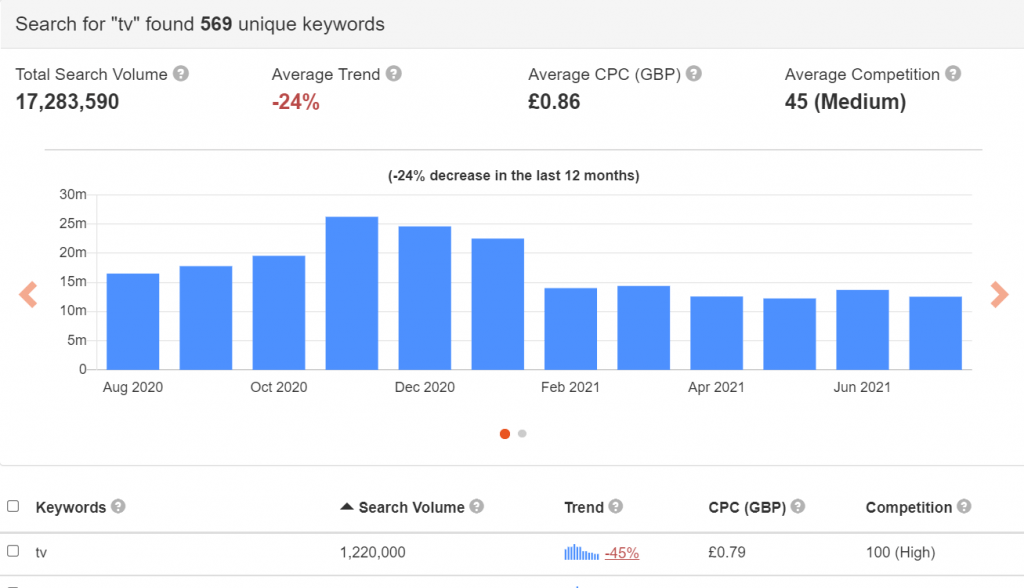
To show you how important it is to do this thorough keyword research we will show you an example. In this we have a webshop that sells all sorts of products, we will take a look at televisions. So, we will be comparing “television” with “tv” to see which one is the right keyword to use.
We checked both keywords with our tool (in this case we used keywordtool.io) and saw quite the difference between the two. TV has almost twice as much search volume as television. What is also visible is that the tool can find almost 9x more search volume on related keywords for TV than for television. In this example you can see how important it is to have looked into this, because you might’ve gone for “television” because that’s the full word, but the best keyword to use in this case is “TV”.
The steps of doing the keyword research
Now that you know what keyword research is and why it is important, we’re going to go into the steps of doing the actual keyword research. We will give you 9 steps that need to be taken to be able to do a thorough keyword research.
1. Get the right tool
We can’t stress this enough, but picking the right tool is the very first step you’re going to need to take. You are going to need a tool that is specially made to be able to show search volume and also relevant keywords to the one you filled in. At Direct Impact we use three tools for our keyword research: Semrush, Keyword Tool and Answer The Public. All of these tools are paid tools, but they will also give you the best results. You can also use the free tool from Google: Google Keyword Planner. The downside to this free tool is that you will only get an approximate search volume, which makes your research less accurate. Our SEO specialists would not recommend using Google Keyword Planner for keyword research for SEO.
2. Study your industry and target audience
Once you have your tool, don’t just start with your keyword research. Your next step is knowing everything about your industry and your target audience. You have to know exactly what categories your products/services fall in, what the appropriate naming conventions are and what type of target audiences you are going to target. This will help you learn more about your topic or niche and will often help you get out-of-the-box ideas. Once you have full knowledge about both, you will be able to form a SEO strategy on several angles.
3. Define your SEO goals
Next up is defining your SEO goals. SEO is a field of expertise where you need to put your focus on certain aspects of SEO. The same goes for keyword research, it’s going to take time to investigate them all, write the content, etc. Setting a goal can help you with your keyword research. If you know what you want to reach, you can calculate how much search volume you will need to get to that goal. Your goal might be an increase in organic traffic by 30%, which in this example is 1000 sessions. When you set a goal for SEO, it’s also important to make it realistic. So, if you’re starting out with SEO, set your goal to have your keywords placed between 4-10. In our experience you can take a CTR of 5%. Now it is already easy to know how much volume you need: 20.000. So here’s your answer, to reach your goal, you must find keywords for pages that will get you at least 20.000 search volume per month. You can use this basic formula to also calculate other goals like an increase in revenue. You will just need to add the right calculations to the funnel.
4. Divide your business into relevant topics
Now that you’ve done all the prepping for the keyword research, it’s time to start focusing on the keywords themself. For example you might have a webshop with over 2.000 items. Now, taking into consideration that it will take at least an hour to write the content, that’s one hell of a job. So where you want to start is dividing your business into main topics. For example you might think of: Laptops, Desktops, Smartphones, TV’s, Books, etc. Google is also very fond of categorisation and the better you categorize your products under main topics, the better Google will understand how to rank you, meaning you will get better results. In this way you are not only doing SEO, but also a bit of CRO by helping your visitors with an easier journey through your website. For keyword research these main topics are also a great way to start off with your keyword research. Most often you will find the keywords with the highest search volume like this, that you can use to really dive deep into the smaller keywords that are related to it.
5. Define the keywords you think are used in searches
If there’s anyone that understands your business and the products or services you sell, that would be you. So don’t forget to use your own knowledge. Most often SEO keywords are quite logical, or at least, the high volume ones are. Just think for yourself “What would I search for if I was looking for my product/service?”. Write these down on a list and just keep going until you feel like you’ve written down the ones you think are logical. For example: You might start off with “Television”. Logically you will add “TV” next. If you keep thinking you will start adding words to it: “Smart TV”, “Buy TV”, “Buy TV online”.
6. Use your defined keywords to find the right keywords
Now that you’ve defined keywords in two ways, it’s time to start using your chosen tool. This is where the real fun starts. You will fill in your keyword, and like magic, your tool is going to show you up to thousands of related keywords. Tools like Semrush and Keyword Tool will show you the monthly search volume, search trend, level of competition and will also show you the average CPC for Search Ads. Answer The Public will not show you the actual search volume or other data, you will need a second tool to check the search volume of given keywords by Answer The Public.
7. Make sure to check the search intent behind keywords
Finding thousands of keywords also means you’re going to have to read through all of them, yes, all of them. Because even though your tool might suggest it as related, that does not mean it’s 100% correct. So, start reading through your keywords and think for yourself “If I would search for X, would I be searching for a product/service/blog?”. The difference between a blog keyword and product/service keyword is especially important to understand. Some keywords are definitely for products/services like: “Buy TV online”. Others are easily recognizable as blog keywords, like: “How do I turn my TV on?”. With practice and experience you will get pretty fast in being able to recognize what kind of page the keyword is for. Until then, use the simplest trick in the book: Google it.
8. Scan and compare your competitors
This is where a tool like Semrush really starts to shine. Because SEO is a field of competition. But, how can you see the data of your competitors? Well, you don’t have to see all of it to understand at what level they are. A tool like Semrush can actually compare your rankings to competitors. It can do this on both a keyword ranking level as authority (off-site SEO). Semrush probably has the best competitor check, because you can actually get the exact list of keywords your competitors are ranking for, but you are missing or ranked lower on. You could also use Semrush to check the current status of some technical performance of their website. A tool like SEO Spider Frog (not used for keyword research) can also really help you get some valuable data on the website of your competitors. Be smart, scan your competitors, know at what level they are and compare that to yours. Use that information to know what you need to do to catch up and excel.
Do you want to do SEO like a boss? Get in touch.